
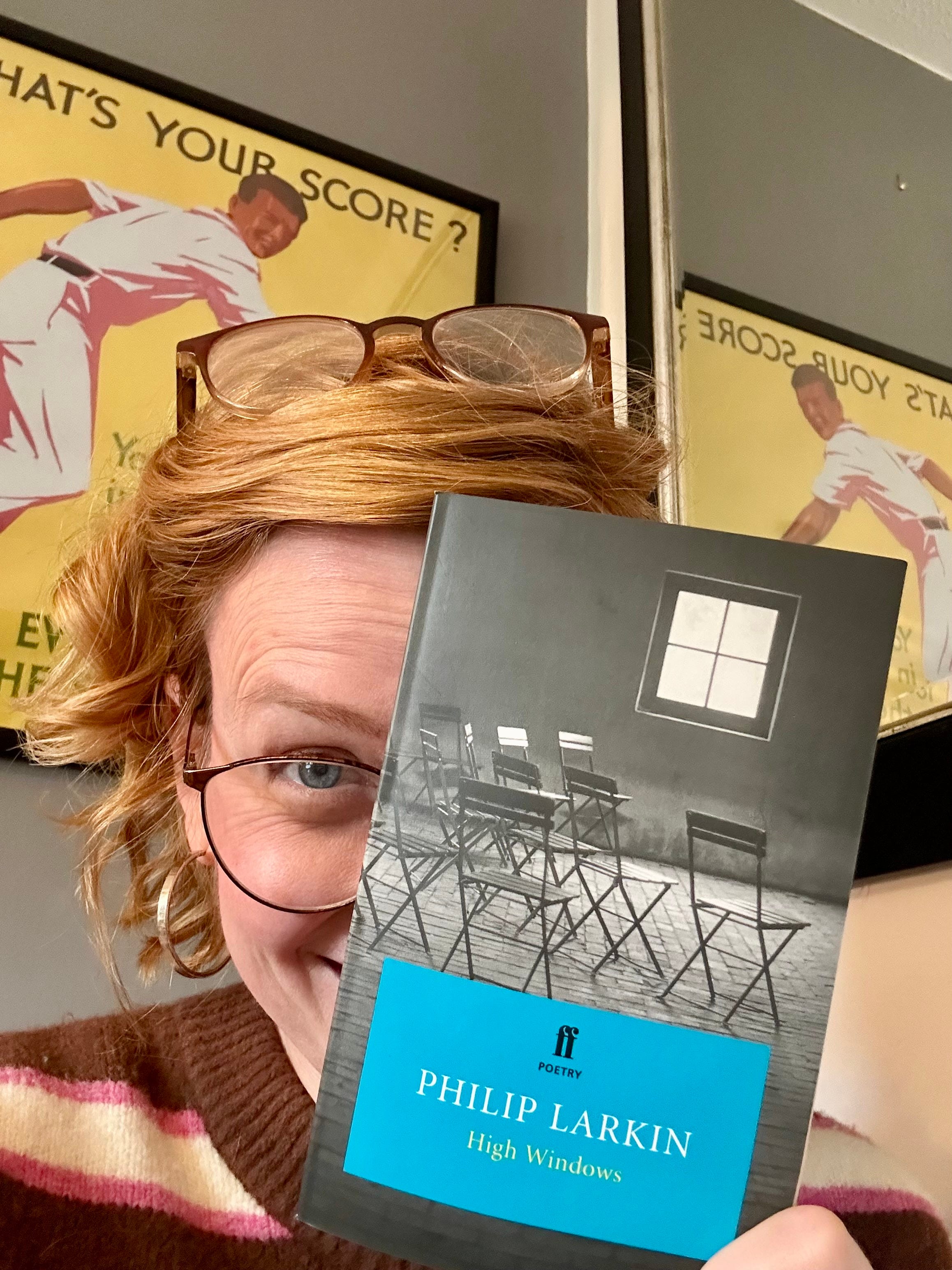
One thing I’m realising more and more as I write these pieces is that I acquired much of my poetry in a decidedly circuitous and fumbling manner. Philip Larkin came to me third-hand: at sixteen I hadn’t read a word of his poetry, and I hadn’t read Andrew Motion’s reportedly honest and affectionate biography of him, but I had read Alan Bennett’s honest and affectionate review of Andrew Motion’s reportedly honest and affectionate biography of him*1. The things we did before the internet. So Larkin arrived kind of distorted, a figure peered at through the wrong end of a telescope and through the lenses of two other men, this grumpy man in glasses who shagged his way round the library personnel of the North of England and had a soft spot for both Thatcher and Hitler, the kind of guy who’d take a girl on a date and later write to his friend
Don’t you think it’s ABSOLUTELY SHAMEFUL that men have to pay for women without BEING ALLOWED TO SHAG the women afterwards AS A MATTER OF COURSE?
Based on this picture, I assumed that his poetry probably wouldn’t be for me, and I moved on. I was about to be swept off my feet by Dylan Thomas, who I hadn’t read a review of a biography of, so that was fine.
But over the years Larkin poems dropped quietly one by one into my life: This Be The Verse, of course, and then The Trees, An Arundel Tomb, The Mower. I found it hard to compute, having read the biographical stuff first, that the man who wrote such tenderness as
begin afresh, afresh, afresh
and
what will survive of us is love
and
we should be kind while there is still time
was in fact the same bloke who Motion refers to as ‘a sexually disappointed Eeyore’. Well, this is why you’re supposed to meet the poems before the poet, and sometimes not the poet at all. Poets are real people, and flawed. It’s the poems that keep us fond of Larkin.
High Windows is Larkin’s final, short, collection from 1974, published with no dedication and no acknowledgements page. My little copy comes from a Faber poetry box set I picked up second hand when I started my MA, which is called Poetry Essentials but really should be called All The Poetry Collections You Were Convinced You’d Read But Actually Haven’t And Really Should Lest Someone Find You Out.*2 Larkin is lovely to read, because you don’t have to be on edge - he’s, poetry-wise, a pair of safe hands and once you figure out what a poem is doing he’ll get you to the end. He’ll rhyme but not make a song or dance about it. He’ll tread carefully and place every word precisely where he means to. He’ll tell you about things that happen in real life, and isn’t afraid to have a moan, and isn’t afraid to give us a bit of hope. It’s endearing - it just is.
Larkin’s long-term lover Monica Jones said ‘he cared a tenth as much about what happened around him as what was happening inside him.’ He cared so much about that that he asked for his diaries to be destroyed when he died, which they were. In High Windows, we find this poem:
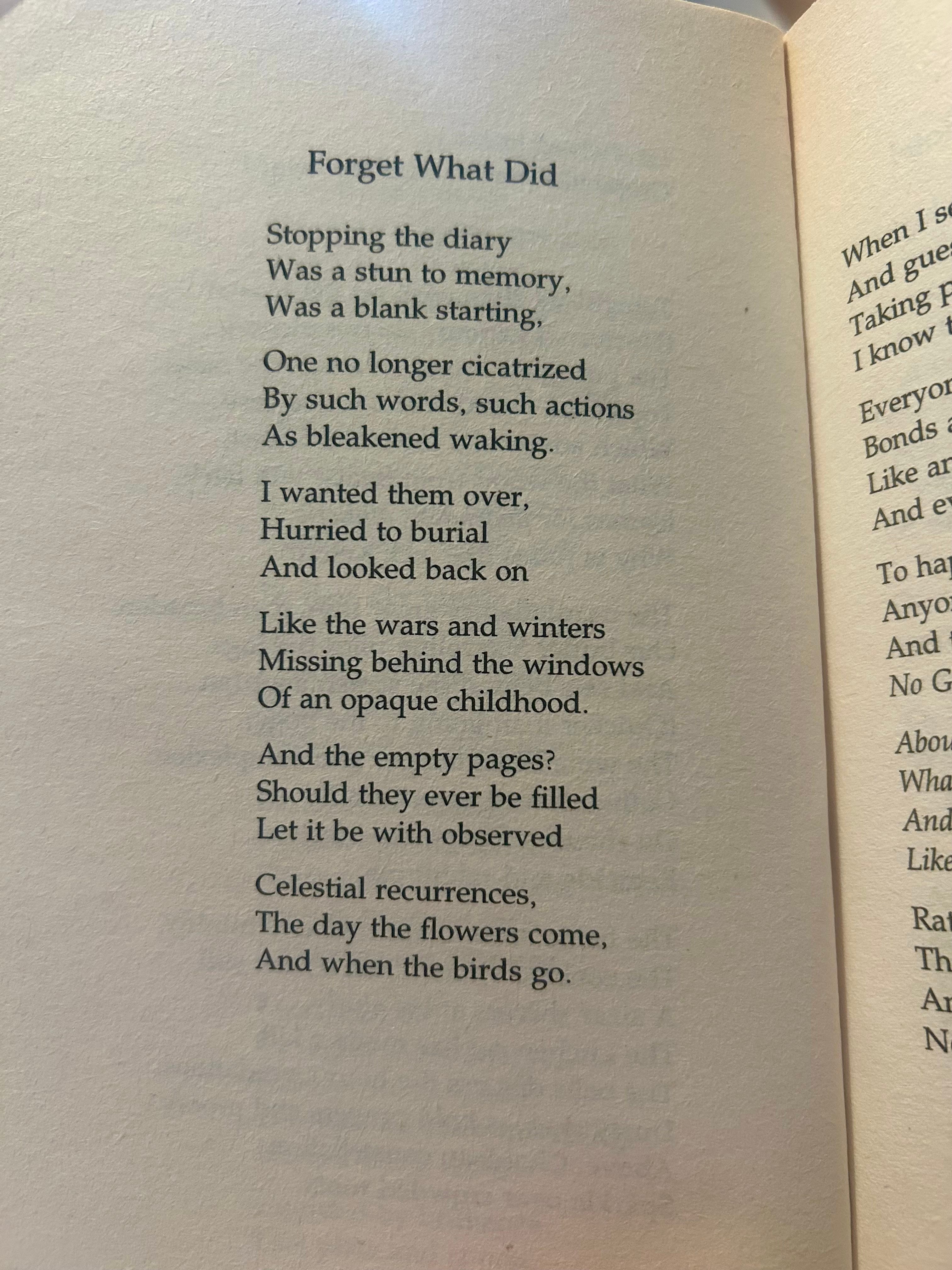
This is quite a new poem to me, and I’m very taken with it. Because his diaries were destroyed, we don’t know when or indeed if he did stop writing them. But I’m really intrigued by his idea that writing a diary is ‘cicatrizing’ - that it heals by forming a scar. He doesn’t want that, in this poem. He’d rather have opacity, a ‘blank starting.’ Perhaps he’s done with recording the intricacies of a quotidian life - I want predictability, universality, he seems to be saying; record the moon cycle, the birds leaving, the things that are important. That so much of his poetry seems to directly contradict this sentiment is interesting, though, isn’t it? All those poems about normal life and the ins and outs of it are the poems that made him famous, and there are plenty of those in this collection too. Turn the page and he’s telling us they fuck you up, your mum and dad.
Man, Larkin could write. But I’m still not sure we would have ever seen eye to eye. As a stressed student struggling to finish a poem that was getting the better of me, I came across him saying this on the uncertainties of poetry*3
The only consolation in the whole business … is that in all probability there was really no choice.
and in my notebook I wrote ‘Well I’m PARALYSED by bloody choice, Philip!’ He was probably right. But I can be quite grumpy myself.
*1 as published in Writing Home, the collection of Bennett’s writing that came out in 1995. My mum bought me this book for Christmas when I was sixteen because I had loved Talking Heads at school. I loved it and read it cover to cover several times, despite understanding literally none of his literary or theatrical references.
*2 it’s a lovely little box set: Sassoon, Plath, Hughes, Eliot, Armitage, Cope, Auden, Heaney…
*3 Don’t Ask Me What I Mean: Poets in their own Words by Clare Brown and Don Paterson, 2003
Thanks for introducing me to this poem Nia. I share many of your responses to Larkin and came to him late! But every Spring two of his lines are waiting for me… I chant them inside my head, bore my friends again…
The trees are coming into leaf
Like something almost being said
I can’t begin to explain the power of that simile but it’s brilliant, beyond analysis!
What larks indeed!
Separating the art from the artist is always the rub - perfectly articulated here. So enjoyed this, thank you Nia.